
The Myth of the “Holy Grail” in Futures Trading
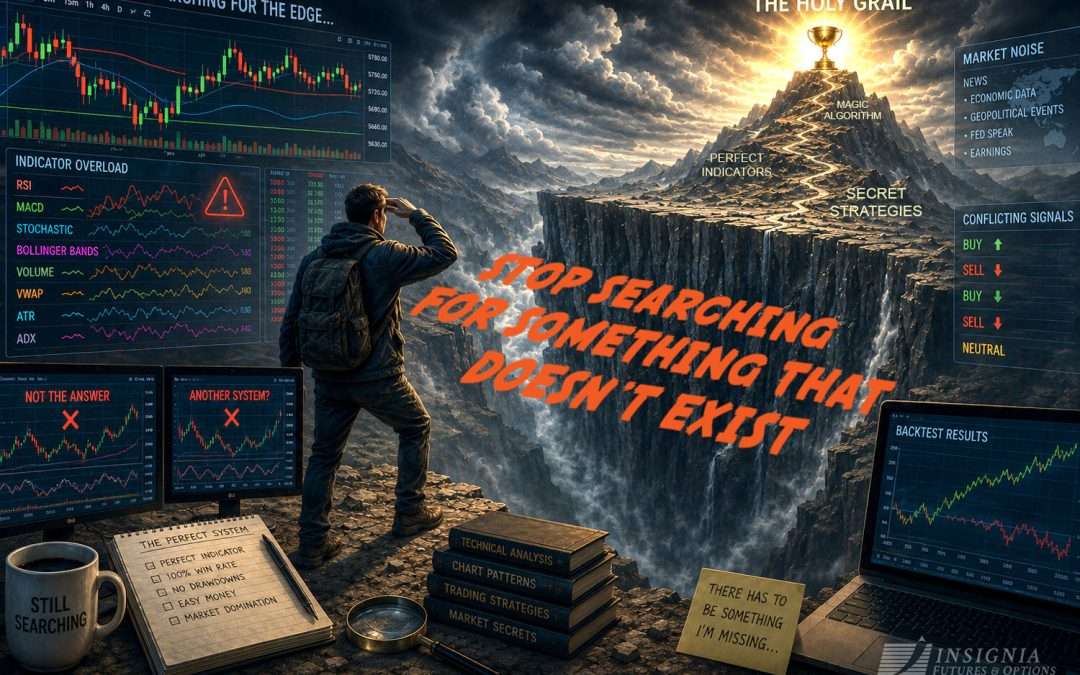
I’ve been a futures broker for 25 years and I can tell you, there is no holy grail – no secret method that only the ‘pros’ know, to trading the futures markets.
I’ve seen many new futures traders enter the markets searching for a shortcut.
Some search for the perfect indicator. Others search for the perfect chart pattern, algorithm, trading room or secret strategy that will supposedly help them dominate the markets with little effort. Social media and online trading communities often reinforce the belief that somewhere there is a “holy grail” system capable of predicting every market move.
Experienced futures traders eventually discover that no indicator, strategy or technical tool can consistently predict every market move under all market conditions. Markets are influenced by changing volatility, economic reports, geopolitical events, institutional positioning and constantly shifting trader sentiment. What works well in one environment may perform poorly in another.
Instead of searching endlessly for a magic indicator, I suggest you shift your focus toward discipline, structure, risk management and consistency.
These concepts may not sound as exciting as discovering a “perfect” strategy, but they often play a far greater role in helping traders develop a more organized and repeatable approach to the markets.
Why do Traders Keep Searching for the “Holy Grail”?
The answer is simple; no one wants to have a losing trade. The reality is you will have losing trades – there is no way around this. What’s important is ‘how’ you manage the inevitable losses.
Trading can be emotionally challenging because markets are unpredictable. Most traders dislike uncertainty and losses, so they continually search for tools that appear capable of eliminating risk or improving win rates dramatically.
This often leads traders into a cycle of:
- Constantly changing indicators
- Modifying trading systems
- Overanalyzing charts
- Purchasing new strategies
- Abandoning trading plans after short-term losses
The result is usually inconsistency.
Instead of gaining experience and discipline with your trading strategies, many traders spend months or years jumping between systems while never fully developing confidence in any particular approach.
No Indicator Can Predict Every Market Move
Now I’m not saying that technical indicators are useless – quite the contrary, many can be useful tools for analyzing market conditions, identifying trends or measuring momentum. However, indicators are simply mathematical calculations based on historical price data. They are not crystal balls – they can’t predict the future.
For example:
- Moving averages may help identify trends
- Oscillators may help measure momentum
- Volume analysis may help identify participation
- Support and resistance zones may help identify areas of interest
But none of these tools guarantee future price movement.
Even strong technical setups can fail unexpectedly due to:
- Economic reports
- Geopolitical events
- Unexpected volatility
- Changes in market sentiment
- Institutional order flow
This is one reason many experienced traders focus less on trying to predict every market move and more on managing risk when trades do not behave as expected.
Discipline Typically Matters More Than Indicators
Many traders eventually discover that trading discipline is more important than finding additional indicators.
Discipline can include:
- Following a structured trading plan
- Avoiding impulsive trades
- Maintaining consistent position sizing
- Respecting stop-loss levels
- Reviewing trades objectively
- Avoiding emotional decision-making
Without a disciplined trading plan, even a well-designed strategy can become inconsistent.
For example, a trader may have a reasonable setup but:
- Enters trades emotionally
- Increases position size after losses
- Removes stop-loss orders or moves them farther away
- Overtrades during volatile conditions
- Abandons rules after a losing streak
These behaviors often create larger problems than the trading strategy itself.
Risk Management Usually Matters More Than Trade Entries
One of the most overlooked concepts among newer traders is risk management.
Many traders spend enormous amounts of time trying to improve entries by a few ticks while spending very little time managing risk exposure. However, experienced traders often understand that preserving capital is just as important as finding trade opportunities.
Risk management concepts include:
- Limiting risk per trade
- Using stop-loss orders
- Avoiding oversized positions
- Managing daily loss limits
- Reducing emotional decision-making
- Understanding market volatility
Even strong trade setups can fail unexpectedly. Risk management helps traders define exposure before entering a trade rather than reacting emotionally after the market moves against them.
This is one reason many traders eventually move away from searching for “perfect” indicators and instead focus on creating more structured trading processes.
Structured Trading Plans Help Reduce Emotional Decisions
A structured trading plan can help traders organize their approach to the markets.
Trading plans often define:
- Markets being traded
- Preferred trading hours
- Chart timeframes
- Entry criteria
- Risk parameters
- Trade management rules
- Target prices for both profit and loss
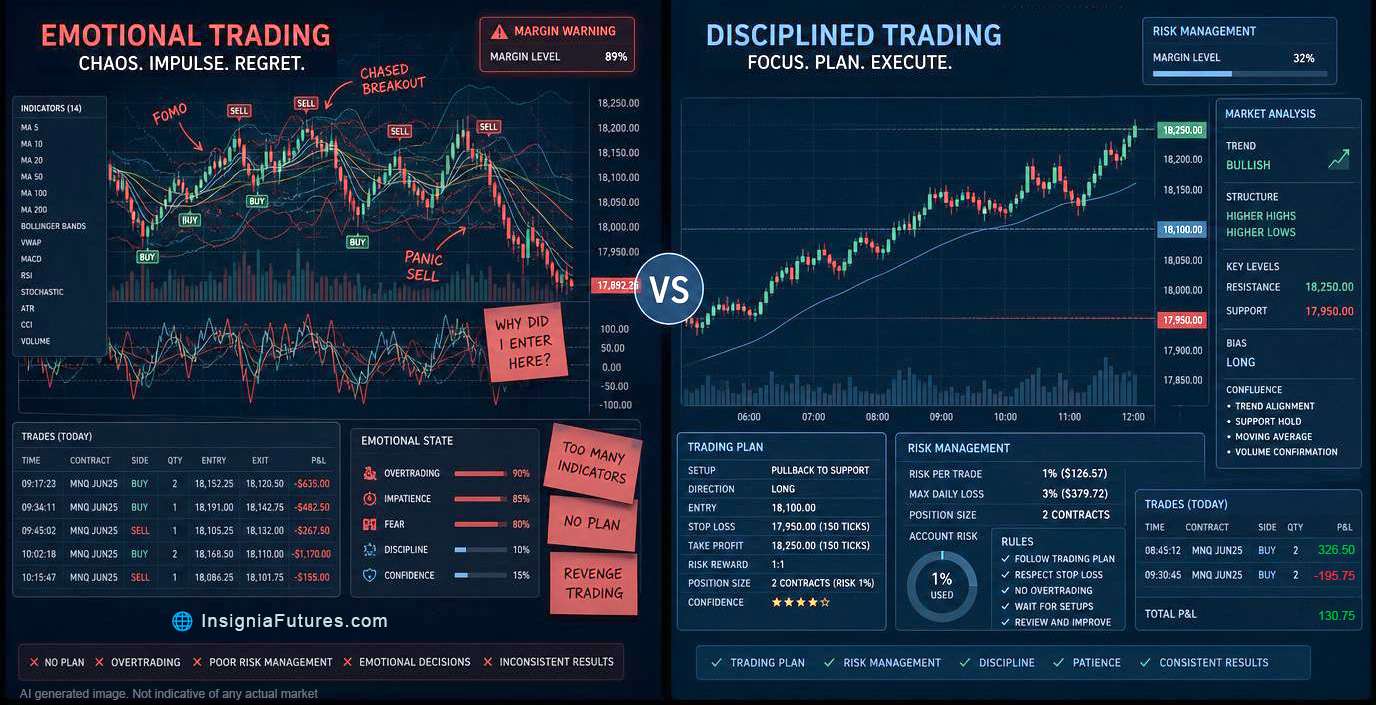
Having a structured trading plan may help reduce emotional reactions during fast-moving market conditions.
Many traders also benefit from reviewing their trades regularly to identify:
- Recurring mistakes
- Emotional trading behavior
- Inconsistent execution
- Risk management issues
- Changing market conditions
I recommend keeping a log or trading journal of every trade you make which includes the reasons you took the trade and the outcome. Over time, this review process may help traders refine their approach and improve consistency.
For traders looking to build a more structured approach to the markets, our futures day trading guide explains how to develop a structured futures day trading plan discusses trading plans, chart analysis, risk management concepts and trade management techniques commonly used by active traders.
The Markets Will Always Be Uncertain
One of the most important lessons traders eventually learn is that uncertainty is part of trading.
No indicator can eliminate uncertainty completely.
Markets constantly evolve as:
- Volatility changes
- Liquidity shifts
- Economic conditions develop
- Institutional participation changes
- Shifts in trader sentiment
Accepting this uncertainty often helps traders focus on the areas they can control such as:
- Discipline
- Consistency
- Preparation
- Position sizing
- Emotional control
- Risk management
Final Thoughts
The “holy grail” in futures trading does not exist.
There is no single indicator, chart pattern or strategy capable of predicting every market move consistently. Traders who spend years searching for perfect systems will eventually discover that long-term consistency often depends more on discipline, structure and risk management.
While technical tools can certainly play a role in market analysis, many experienced traders focus heavily on maintaining a repeatable trade strategy, managing risk exposure and staying disciplined during changing market conditions.
In many cases, these habits typically matter far more than searching endlessly for the next “magic” trading indicator.
Ready to learn more about futures trading? Explore our Futures Educational Resources or Open a Futures Trading Account today.
Discover Futures Trading at its Best.

Questions? Leave them in the comments below or feel free to contact me directly – I’ll be happy to help!
Joe Fallico
Principal Futures Broker
Series 3 / Series 30 Licensed
Phone: 1-847-379-5000 – ext. 101


0 Comments