
How to Trade Crude Oil Futures: A Step-by-Step Guide to WTI (CL) and Micro (MCL) Contracts
Learn how to trade oil futures, how CME Group WTI and Micro contracts differ and what active traders should understand before placing a trade
Oil futures are among the most actively traded commodity futures contracts because they provide direct exposure to one of the world’s most important energy markets. It is important to understand contract size, tick value, margin requirements, trading hours and risk before entering a trade.
This guide explains how to trade oil futures step by step, how WTI crude oil futures work, how to compare standard CL and Micro contracts and what traders should know about leverage and volatility. If you are looking for a practical introduction to trading Oil futures and opening a futures trading account, this page is designed to provide a clear foundation.

What Are Oil Futures?
Oil futures are standardized futures contracts that allow market participants to buy or sell crude oil at a predetermined price for delivery in a future month. These contracts trade on regulated futures exchanges and are commonly used by active traders, commercial firms and hedgers to participate in or manage exposure to changing oil prices.
The most widely followed U.S. oil futures contract is the WTI Light Sweet Crude Oil contract, which trades under the symbol CL on the CME Group futures exchange. Although the contract is physically deliverable, most futures traders close or roll their positions before expiration rather than taking or making delivery.
Quick Take: If your goal is direct exposure to oil price movement through a standardized futures market, WTI crude oil futures are typically one of the primary contracts traders evaluate because of their liquidity, volatility and global relevance.
How to Trade Oil Futures Step by Step
If you want to learn how to trade oil futures, the process usually begins with opening a futures trading account, selecting the contract you want to trade and understanding how price movement affects profit, loss and margin. The steps below provide a simple framework.
1. Open a Futures Trading Account
The first step is to open a futures trading account with a registered futures broker such as Insignia Futures & Options. Once your account is established and funded, you can access your futures trading platform and begin trading.
2. Choose the Right Contract
Before placing a trade, it is important to understand how Crude Oil futures contracts are structured, including contract size, tick value, leverage and trading hours. Traders who are new to the futures markets may also benefit from reviewing our Get Started with Futures Trading guide before trading Crude Oil futures.
3. Learn Tick Value and Margin Requirements
Before placing a trade, understand how much each tick is worth and how much capital is required. Reviewing current margin requirements for futures trading is an important part of the process.
4. Select the Contract Month
Choose the Crude Oil futures contract month you want to trade. Many active traders focus on the front-month contract because it typically has the most activity.
5. Enter an Order
Choose your direction, order type and quantity. Common order types include Market, Limit and Stop orders.
6. Manage Risk and Position Size
Know your stop level and profit target before entering an order and size the trade so the dollar risk fits your account and trading plan.
Ready to start trading Crude Oil Futures? Open your account to access a professional futures trading platform, exchange-direct order routing and support from a brokerage serving futures traders worldwide since 2001.
Why Traders Use Oil Futures
Oil futures are popular because they provide access to a highly liquid global commodity market with extended trading hours and active price movement. Traders and hedgers use these contracts for different reasons depending on their objectives and market outlook.
Active Price Movement
Crude oil is known for price volatility, which can create trading opportunities during both quiet periods and major news-driven market moves.
High Liquidity
Both full size and micro WTI crude oil futures are among the most actively traded energy contracts, which can support efficient order entry and exit strategies.
Extended Trading Hours
Oil futures trade 23 hours a day – 6 days a week, allowing market participants to respond to global developments and news events as they happen.
Traders who actively follow Crude Oil futures may also want to review our futures trading services for experienced investors to better understand the brokerage support, trading tools and account resources available through Insignia Futures & Options.
Futures Trading Advantage: Oil futures allow traders to take either long or short positions, making it possible to participate in rising or falling oil markets depending on your market outlook and trading style.


Discover Futures Trading at its Best
Discover Futures Trading at its Best

Have Questions?
We’re here to help – Connect with a licensed futures broker now.
WTI vs Micro WTI Oil Futures
The two most common oil futures contracts for active traders are the standard WTI crude oil futures contract and the Micro WTI crude oil futures contract. Both track crude oil pricing, but the Micro contract is smaller and can offer more flexibility in position sizing.
WTI Crude Oil Futures
The standard WTI crude oil futures contract uses the ticker symbol CL. Each contract represents 1,000 barrels of crude oil and the minimum price fluctuation is $0.01 per barrel, which equals $10 per tick.
Micro WTI Crude Oil Futures
The Micro WTI crude oil futures contract uses the ticker symbol MCL. Each contract represents 100 barrels of crude oil. Because it is one-tenth the size of the standard contract, it can make position sizing more flexible for smaller accounts.
The standard CL contract may be more appropriate for traders seeking larger dollar exposure, while the Micro contract (MCL) may appeal to traders who want to scale in more gradually or reduce per-contract risk. Both contracts track crude oil, but the dollar effect of each price move is very different.

Ready to get started? Open your futures trading account:
Oil Futures Contract Specifications
Before trading oil futures, it is important to understand the key contract specifications because they directly affect position size, tick value and risk.
- Standard WTI crude oil symbol: CL
- Micro WTI crude oil symbol: MCL
- Standard WTI contract size: 1,000 barrels
- Micro contract size: 100 barrels
- Minimum tick: $0.01 per barrel
- Tick value: CL = $10.00 per contract / MCL = $1.00 per contract
- Primary crude oil options symbol: LO
- Contract months: All 12 months
Understanding these specifications helps traders estimate dollar risk, compare contract choices and calculate the impact of price movement before entering a position.
How Oil Futures Symbols Work
Each oil futures contract includes a root symbol, a month code and a year code. For example, CL.V26 identifies the October 2026 crude oil futures contract. Traders select the specific contract month they want to trade based on liquidity, timing and expiration.
Many active traders focus on the front month, which is typically the contract with the highest trading volume and the tightest market activity. Knowing how to read the contract symbol is important because the exact month affects liquidity, rollover timing and expiration risk.
Trade Entry Basics
When placing an oil futures order, traders typically specify:
- Contract Symbol
- Contract Month
- Trade Direction (Buy or Sell)
- Quantity
- Order Type (Market, Limit or Stop)
- Time in Force (Day or Good Til Canceled)
Once the order is accepted and filled, your trading account will reflect the futures position and will track your profit/loss. Working orders can generally be modified or canceled prior to being filled or expiring.

How Profit and Loss Are Calculated
The standard WTI crude oil futures contract trades in $0.01 price increments. Because each CL contract represents 1,000 barrels of crude oil, a $0.01 move equals $10.00 per contract. A $1.00 move in crude oil prices equals a gain/loss of $1,000.00 per contract.
Example: WTI Crude Oil (CL) P&L Calculation
- Trade entry at: 77.62
- Trade exit at: 78.22
- Difference: 0.60
- Profit/Loss: 0.60 x 1,000 = $600
*Trade fees must also be accounted for when calculating your overall profit / loss.
Crude Oil Futures Margin Requirements
Margin is the amount of funds required to open and hold a futures position. It is not a loan as in stock trading. Futures margin requirements function like a performance bond and are set by the futures exchange and broker.

Day-Trade Margin
Day trade margin is the amount of funds required to hold a futures position within the current trading session. It typically offers the highest leverage, meaning traders can control larger contract values with less capital.

Initial Margin
Initial margin is set by the futures exchanges and is the amount of capital required to hold a futures position longer than one day. Some futures brokers may require higher margin amounts based upon current market conditions.

Maintenance Margin
Maintenance margin applies beginning on the second day a position is held and represents the minimum account equity required to keep that position open. If account equity falls below this level, a margin call will be issued.
Margin policies, trading platforms and order execution can vary greatly between brokerage firms, which is one reason many active traders compare features when selecting the best futures broker for Crude Oil futures trading. Keep in mind, margin requirements are subjext to change without notice, so traders should always review current requirements before trading.
Important: Reduced day-trade margins can increase flexibility for active traders, but leverage also increases risk. Position size should always be planned with risk in mind, not just minimum margin requirements.
Review our current margin requirements before placing trades.
What Moves Crude Oil Futures Prices?
Oil futures prices can respond quickly to changes in supply, demand and global market sentiment. Active traders often monitor both technical price action and fundamental developments that may affect the energy markets such as:
- Global supply and demand conditions
- OPEC and other producer policy decisions
- Weekly U.S. inventory data
- Geopolitical events affecting production or transportation
- Economic data, inflation expectations and currency movement
Because oil is a globally traded commodity, headlines and scheduled reports can create sudden increases in volatility. Understanding these drivers can help traders prepare for changing market conditions.
Traders often combine these factors with structured futures trading strategies when evaluating potential trade setups.
Trading Hours for Oil Futures
Oil futures trade 23 hours a day – Sunday through Friday. This allows traders to respond to international developments, inventory reports, geopolitical headlines and other events that can affect oil prices outside regular U.S. business hours.
Liquidity and volatility can vary by time of day, so active traders should understand when the market is most active and when scheduled reports are released.
Traders can also review our complete guide to futures trading hours to better understand how different futures markets operate throughout the trading week.

Review our current margin requirements before placing trades.
Options on Crude Oil Futures
Options on oil futures can provide additional strategic flexibility beyond outright futures positions. These contracts may be used for directional trades, hedging or defined-premium strategies depending on the approach used.
If you are new to trading futures options, it is generally helpful to first understand how the underlying oil futures contract behaves before adding options strategies to your trading approach.
Risk Management When Trading Oil Futures
Oil futures can move quickly, and leverage can magnify both gains and losses. Fast-moving energy markets can affect account equity rapidly, especially during major reports or geopolitical events.
- Understand tick value before entering a trade
- Use position sizing that aligns with your account
- Know whether the trade will be held intraday or overnight
- Use stop-loss orders when appropriate
- Be aware of inventory data, news events and contract expiration dates
A solid risk management plan should always be in place before entering any futures or options trade.
Risk Reminder: Futures and options trading involves substantial risk and is not suitable for every investor. Because leverage is involved, losses can exceed initial margin deposits. Past performance is not necessarily indicative of future results.
Who Trades Crude Oil Futures?
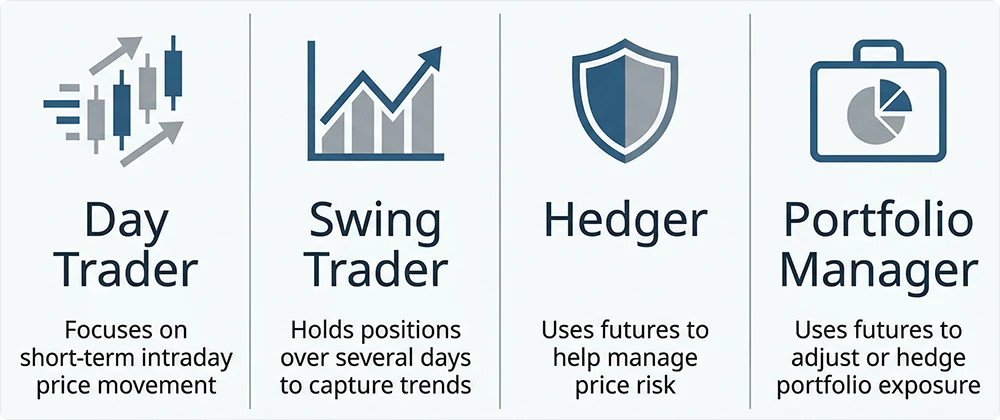
Crude oil futures are used by a wide range of market participants, including active day traders, swing traders, hedgers and portfolio managers. Some use them to express a directional market view, while others use them to manage risk exposure to the energy markets.
- Active day traders seeking intraday price movement
- Swing traders looking for intermediate-term exposure
- Commercial hedgers managing energy price risk
- Traders monitoring inventory reports and geopolitical developments
- Market participants using standard and Micro contracts for different position-sizing needs
Many futures traders do not limit themselves to one market and trade multiple futures markets, such as E-mini S&P 500 futures, as different opportunities develop.
Ready to start trading Crude Oil futures? Open your futures trading account:
Frequently Asked Questions About Crude Oil Futures
What are Crude Oil futures?
Oil futures are standardized contracts that allow market participants to buy or sell crude oil at a predetermined price for a future month on a regulated futures exchange.
Traders who are new to trading the energy markets may also benefit from reviewing our futures trading education resources before trading Crude Oil futures.
Can anyone trade Crude Oil futures?
What Futures Trading Platforms Can I Use?
The vast majority of our clients use our InsigniaTrader Pro platform but we offer most major futures trading platforms including TradingView and Sierra Chart.
We can support most any trading platform that utilizes a Rithmic or CQG data connection. Contact Us for more details.
What is the tick value of a Crude Oil futures contract?
For the standard CL contract, the minimum price fluctuation (tick) is $0.01 per barrel, which equals $10.00 per contract. For the micro MCL contract, the tick value is $1.00 per contract.
What are the symbols for Crude Oil futures?
The standard WTI crude oil futures symbol is CL. The Micro WTI crude oil futures symbol is MCL.
Can you trade Crude Oil futures overnight?
Yes. Oil futures trade on the CME Globex futures exchange 23 hours per day – Sunday through Friday, which allows traders to respond to global news and energy market developments.
How much money do you need to trade Crude Oil futures?
The answer depends on the contract selected, current margin requirements and the trader’s risk plan. Standard contracts involve larger dollar exposure than Micro contracts.
What affects Crude Oil futures prices?
Oil prices are commonly influenced by supply and demand conditions, inventory data, producer decisions, economic trends and geopolitical events.
Take the Next Step
If you are ready to trade WTI Crude Oil futures, the next step is to open a futures trading account with a broker who offers platform access, responsive support and educational resources designed for active futures traders.
At Insignia Futures & Options, traders can access exchange-direct order routing, powerful trading tools, low day trade margins and personalized support from a futures broker serving futures traders worldwide since 2001.