
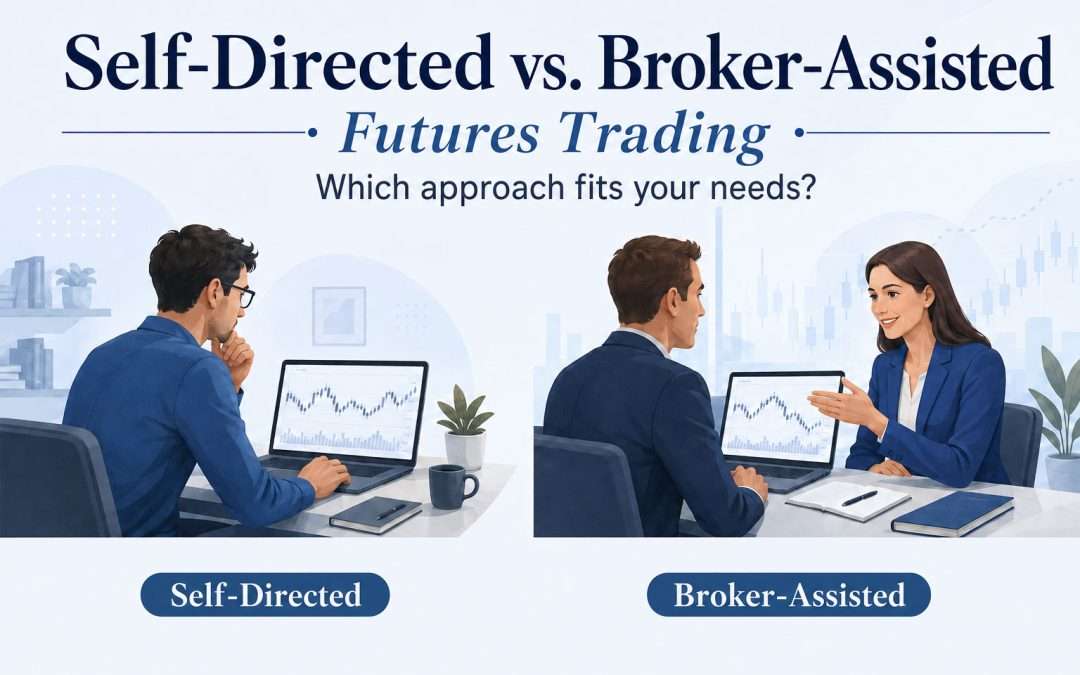
When opening a futures trading account, one of the first things to consider is how much assistance you want from your futures broker.
Some traders prefer to research the markets, develop their own trading ideas and enter their orders online. Others want to discuss a trade with a broker, ask questions about a particular strategy or receive more personalized guidance.
After working with futures traders for more than 25 years, I believe this is an important part of choosing a brokerage. You should feel comfortable with both the trading platform and the people you’ll be working with.
Let’s look at the differences between self-directed and broker-assisted futures trading, and what those differences may mean for you.
What Does Self-Directed Futures Trading Mean?
With a self-directed futures account, you make your own trading decisions and generally enter your orders through an online trading platform.
You decide which markets to trade, when to enter a position, how many contracts to trade and when to exit. You are also responsible for monitoring your positions and understanding the requirements associated with those trades.
For example, suppose you trade the E-mini S&P 500 futures market. You have your own method for evaluating the market, you understand the contract specifications, the margin requirements and you are comfortable placing and managing your orders.
Many futures traders choose a self-directed account plan when opening a futures trading account.
However, there is another question worth asking: What happens when you need assistance?
Even a trader who makes every trading decision independently may occasionally have a question about an order, a platform feature or an account requirement.
At Insignia Futures & Options, our self-directed account plans include access to our 23/6 Trade Desk as well as access to experienced, licensed futures brokers. You can manage your own trading while still having someone to contact when a question comes up.
What Does Broker-Assisted Futures Trading Mean?
A broker-assisted trading account plan gives you the opportunity to work directly with a futures broker.
That relationship includes discussing your trading ideas, reviewing how a particular strategy works or receiving trade recommendations.
This account plan can be attractive to those traders who like knowing they have someone to discuss their trade ideas with or who are looking for futures trade recommendations.
At Insignia Futures & Options, our Traders Advantage account plan provides personal broker assistance, education, mentoring and personalized trade recommendations.
For example, you may have an opinion about the direction of a futures market but want to discuss how to approach the trade. Perhaps you are considering a futures contract, an option or a spread and want a clearer understanding of the differences and risk / reward profiles for each.
That is the kind of service a broker-assisted relationship can provide.

How Much Assistance Do You Actually Want?
I would start with a straightforward question:
Which parts of futures trading are you comfortable handling yourself and which parts would you like help with?
You may be comfortable analyzing charts but have questions about futures options. You may understand your trading strategy but prefer assistance with certain order types. You may be entirely comfortable making decisions and entering trades, while still wanting access to an experienced broker when needed.
Your experience level matters, but so does the way you prefer to work.
An experienced trader can still value the opportunity to discuss trade ideas with a futures professional. A newer trader may prefer to learn the platform and develop an independent approach, while asking questions along the way.
The important thing is to understand what your futures trading needs are before choosing your level of service.
When a Conversation with Your Futures Broker Can Be Useful
Sometimes the value of broker support comes down to getting a clear answer to a specific question.
Consider a few examples.
1) You Have a Question About an Order
Suppose you want to protect an open futures position if the market moves against you – do you use a Stop or Limit order? Before submitting that order, you should understand how it will be handled and what its limitations are.
As I explain in my article about futures stop orders, an order may not behave the way a trader expects under every market condition.
If you are unsure how different futures order types work, it’s always better to ask first.
2) You Are Considering a Different Futures Market to Trade
You may be totally familiar with trading stock index futures but may decide you’d like to start trading Crude Oil, Gold or Soybean futures.
Before placing a trade in these markets, you need to understand the contract’s specifications. The tick value, contract size, trading hours and settlement procedures may be quite different from what you are familiar with.
A conversation with a futures broker can help clarify those details before an order is entered.
3) You Want to Discuss a Trading Idea
You may already have an opinion on a market’s direction and want to talk through the mechanics of a potential trade.
What would the position involve? What are the different risk/reward scenarios for an outright futures trade, futures option trade or futures spread trade? What are the different margin requirements for each?
A broker-assisted account plan can give you the opportunity to discuss those questions with an experienced futures broker.
Understand the Support Included with Your Futures Trading Account
When comparing account services, be specific about the assistance you expect.
There is a difference between asking for technical support with a futures trading platform feature and asking for advice on a futures trade you are considering. Make sure you understand which services are included with your account.
I suggest asking:
- Can I contact someone with questions about my platform or account?
- Does this account service include trade recommendations or mentoring?
- How do I reach the trade desk if I need order-related assistance?
- When is my broker available to discuss trading questions?
For example, Insignia Futures & Options provides all clients with access to our 23/6 Trade Desk. Our regular office hours for access to a futures broker are Monday through Friday, 8 a.m. to 4 p.m. Chicago/Central time (excluding market holidays).
Knowing whom to contact and for what purpose, is part of getting comfortable with your futures brokerage firm.
A Futures Broker’s Perspective
When choosing between a Self-Directed and Broker-Assisted trading account plan, think about the relationship you want with your futures broker.
If you prefer to make your own decisions and enter your own orders, look for a service that supports that approach. If you want more personal guidance, trade recommendations and the opportunity to discuss your trading ideas, ask about broker assistance.
In either case, you should understand the trades you make and the risks involved. Broker assistance cannot guarantee a profitable outcome or protect you from losses.
My suggestion is to have a conversation before deciding. Tell us about your trading experience, the markets you are interested in trading and what you would like assistance with. That gives us a useful starting point for discussing which futures trading account plans may best fit your needs.
Have Questions?
At Insignia Futures & Options, we offer both Self-Directed futures trading and Broker-Assisted account services.
If you would like to discuss the differences, feel free to contact me directly – I’ll be happy to explain the options and answer your questions.

Joe Fallico
Principal Futures Broker
Series 3 & Series 30 Registered
Phone: 1-847-379-5000 ext. 101
Insignia Futures & Options, Inc.