
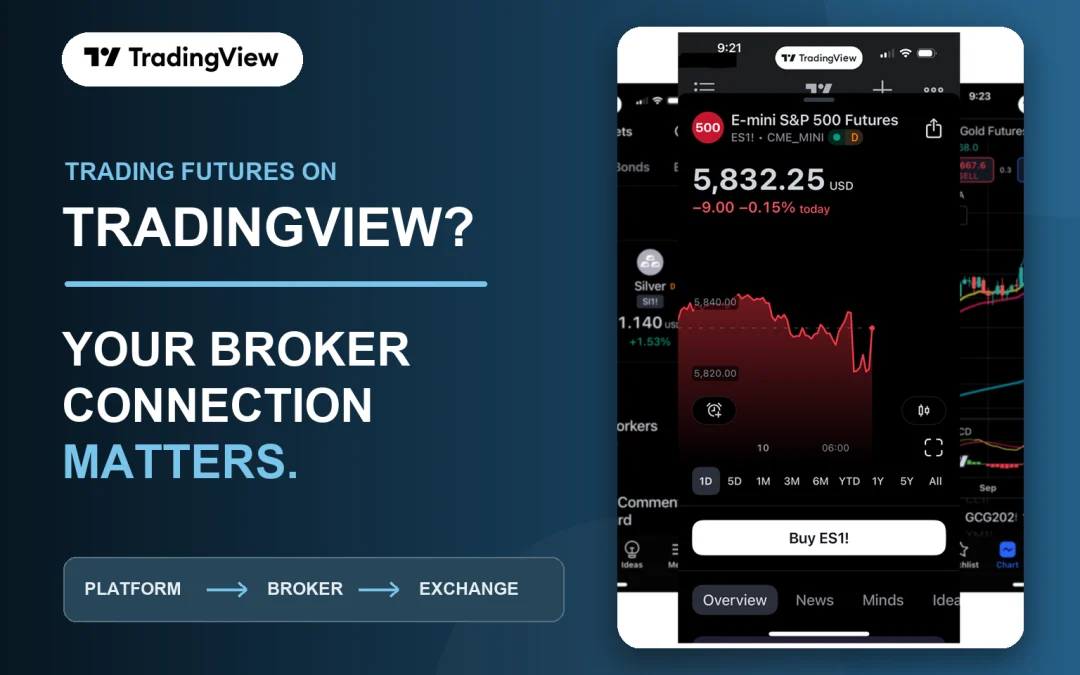
What Happens After You Place a Futures Order on TradingView?
TradingView has become a popular platform among futures traders because of its excellent charting, indicators, drawing tools and ability to access the markets from multiple devices. However, selecting TradingView as your trading platform is only part of the decision.
You also need to decide which futures broker will best support your futures trading.
That choice matters because TradingView provides the interface you use to analyze the futures markets and enter orders, but your broker provides the account, order-routing infrastructure and support behind those trades. Two traders can use the same TradingView charts while having very different brokerage and order-routing setups.
Before selecting a futures broker who supports the TradingView platform, it is important to understand what happens after you click Buy or Sell, and why direct order routing may be an important consideration.
What Is Direct Order Routing?
Direct order routing refers to the path an order takes from the broker’s trading infrastructure to the exchange.
With an Insignia Futures & Options trading account connected to TradingView, eligible orders for CME Group futures markets are routed through our exchange-direct trading infrastructure. Our clearing firm’s CME trade servers are co-located in CME Group’s data center.
This means an order does not first have to pass through a separate third-party connectivity provider before being transmitted to the exchange.
The CME futures exchange then processes eligible orders according to the applicable market’s matching algorithm.

What Are the Benefits of Direct Order Routing?
A More Efficient Route to the Exchange
Every additional system involved in transmitting an order creates another step in the order-routing process.
With exchange-direct routing, the order travels from Insignia Futures & Options’ trading infrastructure to the CME futures exchange without it first being handed off to a separate third-party connectivity provider, such as Rithmic or CQG. This creates a more streamlined route for transmitting new orders, modifications and cancellations.
For an active futures trader, the efficiency of the overall trading connection can be just as important as the appearance of the platform.
Fewer Technology Handoffs
A trading order may pass through several different systems before it reaches an exchange. Each system performs a function, but every additional handoff also introduces another technology dependency and possible delay.
Reducing the number of separate systems involved can reduce potential points of delay or disruption within the routing process.
Third-party order-routing providers can offer dependable futures connectivity, and using one is not automatically a disadvantage. The important point is that traders should understand which companies and systems are involved in handling their orders.
Co-Located CME Trade Servers
Physical distance affects how long it takes electronic messages to travel between trading systems.
CME Group’s co-location facilities place trading equipment close to the CME Globex matching servers and provide low-latency connectivity to the exchange. Insignia Futures & Options’ clearing firm’s co-located CME trade servers are designed to support efficient order transmission for our TradingView and InsigniaTrader clients.
Please note: Your internet connection, location, computer or mobile device can all affect the complete journey of an order.
However, once the order reaches our routing infrastructure, co-location helps provide an efficient connection to CME Globex.
A Clearer Support Path
Technology becomes especially important when an order is rejected, a connection is interrupted or a trader has a question about an open position.
When multiple providers are involved, determining which system is responsible for an issue can become more complicated. Was the issue caused by the platform, the data connection, the order-routing provider, the brokerage account or the exchange?
A more direct routing arrangement can simplify part of that structure. At Insignia Futures & Options, the TradingView connection is paired with access to our futures brokerage team and trade desk. If you have a question about your account or an order, you have someone you can contact rather than relying exclusively on an online help center.
Does Direct Routing Guarantee Better Fills?
No futures broker or trading platform can guarantee a particular fill price or better execution.
Direct order routing can provide a more efficient path to the exchange, but it cannot eliminate the market factors that determine whether, and at what price, an order is filled.
Those factors include:
- The type of order you submit
- Available market liquidity
- The bid-and-ask spread
- The number of orders ahead of yours
- Market volatility
- The speed at which prices are changing
- Exchange matching rules
- Your own internet and device connection
Suppose you submit a market order while an economic report is being released. Prices may move several ticks between the time you click the order button and the time the order reaches the exchange. Even with efficient routing, the market may no longer be trading at the price you saw when you entered the order.
Direct routing cannot prevent that movement or eliminate slippage.
What it can do is provide a streamlined transmission path once your order enters the broker’s routing infrastructure.
TradingView Is the Interface – Your Futures Broker Provides the Trading Account
It is easy to think of TradingView as the entire trading system because that is where you view your charts and place your orders.
In practice, several components work together:
- TradingView displays market data and provides the charts, drawing tools, indicators and order-entry interface.
- Your broker provides the futures trading account, platform connection, order-routing infrastructure and client support.
- The clearing firm carries the account and applies the applicable financial and risk controls.
- The exchange maintains the market and matches eligible buy and sell orders efficiently.
Understanding these different roles can help you evaluate a futures broker more carefully.
A familiar charting interface is valuable, but it does not tell you how the broker routes orders, when day-trade margins are available, what markets are supported, which data subscriptions are required or what kind of assistance is available when you need help.

What Else Should You Ask a TradingView Futures Broker?
Order routing should be an important consideration, but it is not the only one. Before opening an account, I recommend asking the broker several practical questions.
1) Which Futures Markets Can I Trade?
Confirm that the futures & options contracts you want to trade are supported through the broker’s TradingView connection. Do not assume that every futures symbol displayed on a TradingView chart can be traded through every connected brokerage account.
2) Do I Need a Real-Time Market Data Subscription?
For Insignia clients using TradingView, a live market-data subscription is optional and is not required to place orders. However, we highly recommend using real-time data when day-trading. Futures prices can move quickly, and delayed quotes may not reflect the current market price when an order is submitted.
Position traders who make decisions over longer time horizons may not need real-time market data, but they should always know whether the prices displayed in their trading platform are live or delayed.
3) Which Order Types Are Supported?
Confirm that the connection supports the order types you expect to use, including Limit, Stop and Market orders where applicable.
You should also ask what happens to working orders if your browser or device loses its connection. Orders that have been accepted by CME exchange generally remain active according to their designated time-in-force; they are not stored only on your computer. However, certain synthetic or broker-supported orders, such as OCO or Triggered orders, may be managed by the broker’s or routing provider’s servers. With Insignia Futures & Options’ exchange-direct routing, eligible orders are transmitted through our co-located routing infrastructure to the CME exchange.
4) What Support Is Available?
If you have a problem with a platform connection or a question about an order, find out whether you can speak with someone who understands futures trading.
This is an area where the futures broker relationship still matters. A sophisticated charting platform does not replace access to knowledgeable account and trade-desk support.
5) What Are the Account Requirements?
Review the broker’s funding requirements, day-trade margin policies, platform charges, market-data fees and commissions before opening an account.
The lowest advertised commission or day-trade margin should not be your only consideration. The trading platform, order-routing technology and level of support are also major parts of the overall brokerage relationship.
Trading Futures Through TradingView with Insignia Futures & Options
At Insignia Futures & Options, we give traders the ability to combine TradingView’s superb charting and order-entry interface with our futures brokerage services.
Clients using the TradingView platform receive:
- Exchange-direct order routing for supported CME Group markets
- Co-located CME trade-server infrastructure
- Access to major futures markets
- Support from experienced futures brokers
- 23/6 Trade-desk assistance when needed
- A choice of account plans based on your preferred level of service
Once your Insignia Futures & Options account has been approved and funded, we’ll connect your account to the TradingView platform for you to analyze markets, monitor positions and enter orders.
The goal is to give you the total TradingView experience you are familiar with while supporting it with the routing infrastructure and personal service of a futures-focused brokerage firm.
Your Futures Broker Connection Matters
TradingView can be a powerful tool for charting and trading futures, but the platform is only one part of the complete trading setup.
The broker behind the connection determines how your account is structured, how your orders are routed and what type of assistance is available when something goes wrong.
Before selecting a TradingView futures broker, look beyond the charts. Ask how your orders reach the exchange, whether a separate routing provider is involved, where the trade servers are located and who you can contact when you need help.
Would You Like to Learn More?
Contact us today about using TradingView with an Insignia Futures & Options trading account at 1-847-379-5000 or visit our TradingView futures trading page.

Joe Fallico
Principal Futures Broker
Series 3 & Series 30 Registered
Phone: 1-847-379-5000 ext. 101
Insignia Futures & Options, Inc.